
“From the Independence of Cyprus to the Turkish Invasion of 1974 and the Case of Famagusta”
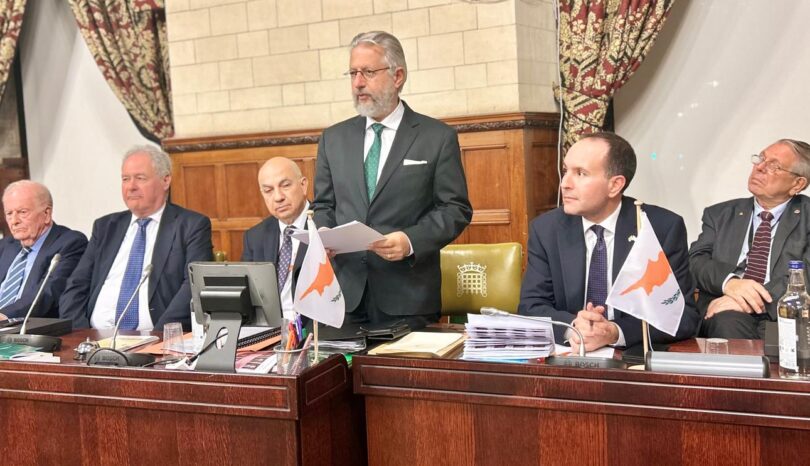
House of Commons, 20 October 2026
Let me first thank the Famagusta Association of Great Britain and its President, Dr Vassilis Mavrou, for inviting me to address you this evening.
I also wish to express our sincere appreciation to Sir Roger Gale MP and Bob Blackman MP for their support and for making it possible for us to meet today here, at the House of Commons.
I equally thank Bambos Charalambous MP –current chair of the APPG on Cyprus, for his long-standing interest in Cyprus-, the National Federation of Cypriots in the United Kingdom, under whose auspices this annual event is organised, and all those who have worked to keep Famagusta present in British parliamentary and public life.
The title of today’s event brings together two defining moments in the modern history of Cyprus: the establishment of the Republic of Cyprus in 1960 and the tragic events of 1974, which violently interrupted the constitutional order and territorial integrity of the then new founded state.
In 1960, Cyprus emerged from colonial rule as an independent and quasi sovereign state. The United Kingdom, Greece and Türkiye assumed specific obligations as guarantor powers of its independence, territorial integrity and security. By the end of the second phase of the military intervention the summer of 1974, it was obvious that the guarantor system did not work as it was designed and we found ourselves with more than one third of the territory of Cyprus under occupation, ever since!
Thousands of people had been killed, hundreds had been raped, hundreds had gone missing and almost half of our population was displaced or forced to immigrate abroad, while all of our society experienced post traumatic symptoms as a result of the consequences of the events described above.
Fifty-two years later, the consequences remain with us. Cyprus is still divided. Turkish military forces continue to occupy part of the territory of a sovereign Member State of the United Nations and the European Union. Displaced Cypriots are still denied the right to return to their homes and properties, and families continue to wait for definitive information about the fate of their missing relatives. At the same time, members of the other community reside in the homes of the displaced and consider the presence of the Turkish army as a necessity for their safety.
This is not only a historical account of events that took place in 1974. It is a description of an ongoing situation. It is also the context within which the case of Famagusta must be understood.
For those who remember Famagusta before 1974, it is difficult to accept that a city can remain enclosed, silent and deprived of its inhabitants for more than half a century. Its people left in August 1974 believing, as so many displaced Cypriots did, that they would return within days. They are still waiting.
Famagusta is frequently described as a ghost town. I have always found this description inadequate. Famagusta is not a ghost. It is a city which was forcibly emptied of its people and has been prevented from continuing its natural life. Its status is neither unclear nor open to arbitrary reinterpretation.
United Nations Security Council Resolution 550 /1984 considers inadmissible any attempt to settle any part of Varosha by people other than its inhabitants and calls for the transfer of the area to the administration of the United Nations. UN SC Resolution 789 / 1992 calls for the extension of the area under the control of the United Nations Peacekeeping Force to include Varosha.
The Security Council has repeatedly called for the reversal of all actions taken in Varosha contrary to these resolutions. Instead, in recent years, we have witnessed further violations of the status of the fenced area and attempts to create new faits accompli on the ground. These actions are not only contrary to the relevant resolutions. They also damage the climate necessary for the resumption of meaningful negotiations and make the already difficult task of rebuilding confidence between the two communities even harder.
We live at a time when the international community is being tested once again by wars, invasions and humanitarian crises. The rules-based international order, which was established to protect states and peoples from the repetition of the tragedies of the past, is increasingly challenged.
In these circumstances, Cyprus does not ask for special treatment. It does not ask for exceptions. It asks for consistency. It asks that the same principles which the international community invokes in every other case should also apply to Cyprus: respect for sovereignty, independence, territorial integrity and international law, as well as compliance with the decisions of the United Nations Security Council.
For Cyprus, these are not theoretical concepts. They concern the continuing division of our country, the rights of displaced people, the fate of the missing and cities such as Famagusta, which remain inaccessible to their lawful inhabitants. When these principles are applied selectively, their credibility is weakened universally.
The recent visit to Cyprus by the Secretary-General of the United Nations, Mr António Guterres, and his decision to work towards the convening of another extended meeting in the 5+1 format, following adequate preparation on confidence-building measures, methodology and substance, constitutes a significant development.
Cyprus President, Mr Nikos Christodoulides, repeated before the UN General Assembly last month that we remain fully committed to achieving a comprehensive, functional and viable settlement, based on a bizonal, bicommunal federation with political equality, as defined in the relevant United Nations resolutions, and fully compatible with the principles, values and acquis of the European Union.
A settlement which will reunify the territory, the communities into one people, the institutions and the economy of Cyprus and create the conditions for all Cypriots, Greeks, Turks, Maronites, Armenians and Latins, to live together in a common, peaceful, secure and prosperous country.
We are ready to resume negotiations from where they were left off, building on the substantial work already achieved. So far, Türkiye is not showing any signs of willingness to allow to the Turkish Cypriot leadership to return to the table of negotiations which they stall since 2017.
Allow me a word on the confidence-building measures. These measures cannot replace a comprehensive settlement. They can, however, help restore trust and demonstrate in practice the benefits of cooperation. The return of Varosha to its lawful inhabitants, in accordance with the relevant UN Security Council resolutions, could be such a measure. It would give substance to the declared commitment to dialogue and create new momentum towards the overall settlement of the Cyprus problem.
Ladies and gentlemen,
The fact that we meet today in the House of Commons is of particular significance. The United Kingdom is not a distant observer of the Cyprus problem. It is one of the three guarantor powers of the Republic of Cyprus, a permanent member of the United Nations Security Council and a participant in the wider format of the UN-led process. Our two countries share a long and complex history, as well as strong contemporary relations. The large Cypriot community in this country forms an important human bridge between Cyprus and the United Kingdom.
The Republic of Cyprus counts on the constructive engagement of the British Government in supporting the efforts of the Secretary-General, safeguarding the agreed basis of the settlement and defending the implementation of the Security Council resolutions concerning Famagusta.
We also count on the continued engagement of the British parliamentarians. Your voice matters. It matters in maintaining Cyprus within the attention of Parliament. It matters in resisting the normalisation of an unlawful status quo. And it matters in encouraging the British Government to exercise fully the role and responsibilities arising from the United Kingdom’s particular relationship with Cyprus.
I wish also to pay tribute to the Cypriot community in the United Kingdom. For decades, its organised bodies and individual members have worked with persistence and a strong sense of civic responsibility to keep the Cyprus problem and the case of Famagusta present in British political and public life. Their purpose, and ours, is not to cultivate hostility between Cypriots or to remain permanently confined by the pain of the past. It is to ensure that the consequences of the unlawful use of force are not accepted as the normal or permanent state of affairs.
Time cannot legalise occupation. It cannot relinquish the rights of displaced people. And it cannot transform division into an acceptable solution. Famagusta is not separate from the Cyprus problem. Its future is inseparably connected with the future of our country and all its people.
We will therefore continue to work peacefully, consistently and with determination for an end to the occupation, for the reunification of Cyprus and for the creation of a common country which will provide freedom, peace and security for all its citizens.
Thank you for your attention.